
Getting Ready for Electronic Invoicing in UAE? Here Are the Latest Updates of February 2026.
The UAE’s digital economy transformation has just crossed a major milestone. On 23 February 2026, the UAE Ministry of Finance published its official Electronic Invoicing (e-invoicing) Guidelines Version 1.0 — a comprehensive document that defines everything businesses and government entities need to know before they begin issuing, exchanging, and reporting electronic invoices.
If you run a business in the UAE — whether you’re a retailer, distributor, service provider, or government contractor — this regulation affects you. And if your operations rely on a Point-of-sale (POS) system, the clock is ticking. The mandatory go-live for businesses with annual revenue above AED 50 million is 1 January 2027, while smaller businesses must be ready by 1 July 2027.
At Inditech, we’ve been closely following the e-invoicing rollout since its inception. We help businesses across the UAE upgrade and configure their POS and billing infrastructure to be fully compliant with the new electronic invoicing framework. In this blog, we break down everything you need to know from the February 2026 guidelines — and show you how Inditech can help you get there, seamlessly.
What Is UAE Electronic Invoicing and Why Does It Matter?
Electronic invoicing — or e-invoicing—is not simply the digitisation of a paper invoice into a PDF. The UAE’s e-invoicing system goes much further. It is a structured, machine-readable XML-format invoice that is issued, transmitted, and received through an officially designated Electronic Invoicing System. Think of it as a live, real-time data exchange between your business, your buyer, your Accredited Service Provider (ASP), and the Federal Tax Authority (FTA).
The UAE government’s rationale for this system is firmly rooted in national priorities. The initiative directly supports the ‘We the UAE 2031’ vision, particularly the Forward Ecosystem pillar, which emphasises digital infrastructure, transparency, and sustainable growth. By adopting e-invoicing, the government aims to:
- Maximise tax compliance and tackle the shadow economy
- Reduce the tax gap and increase audit effectiveness
- Streamline VAT returns and potentially pre-populate them for businesses
- Reduce reliance on paper-based processes, supporting sustainability goals
- Enable near real-time data exchange and policy insights for government planners
For businesses, the benefits are equally compelling. Countries that have already implemented e-invoicing systems — including Saudi Arabia, France, Italy, and India — have observed significant reductions in invoice processing costs, fewer commercial disputes, faster payment cycles, and improved audit responsiveness. The UAE is building on these lessons to create one of the most modern invoicing frameworks in the region.
Understanding the 5-Corner Model: How E-Invoices Actually Flow
The UAE has adopted what is known as the 5-Corner Model for electronic invoice exchange. This framework is based on the internationally recognised Peppol (Pan-European Public Procurement Online) network — the same infrastructure used across Europe and increasingly in Asia and the Middle East. Here’s how it works:
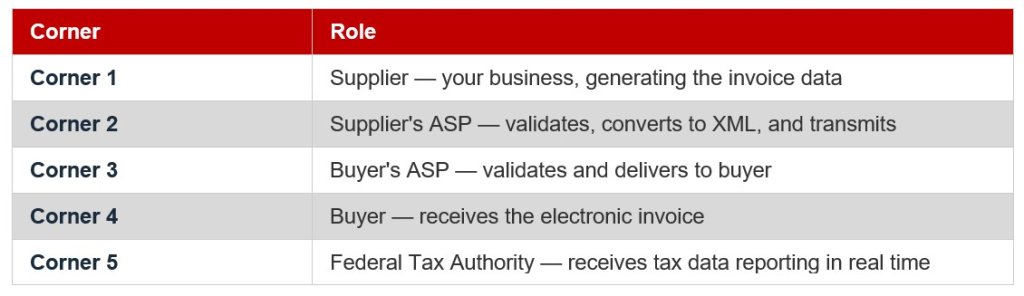
In practice, this means that when your POS or ERP system generates a sales invoice, that data travels through your appointed Accredited Service Provider (ASP), gets validated and formatted in the PINT-AE XML standard, is transmitted securely to your buyer’s ASP, and is simultaneously reported to the FTA. Confirmation messages flow back through the same chain.
Electronic invoices in the UAE do not include QR codes or barcodes. They are structured XML files following the PINT-AE (Peppol International – UAE) billing specifications, which are tailored to UAE tax and regulatory requirements while maintaining interoperability with global Peppol infrastructure.
Who Is Required to Comply? Scope and Exclusions
Who Is In Scope?
Electronic invoicing is mandatory for any Person — natural or juridical — conducting Business in the UAE, in respect of every Business Transaction, regardless of whether they are established in the UAE. Critically, this requirement applies regardless of your VAT registration status.
The transaction types covered include:
- B2B: Business-to-Business transactions
- B2G: Business-to-Government transactions
- G2B: Government-to-Business transactions
- G2G: Government-to-Government transactions
Transactions with individual consumers (B2C, G2C) are NOT in scope for e-invoicing. If you supply only to end consumers, you are excluded — but if any part of your business involves selling to other businesses or government entities, e-invoicing applies.
Notable Specific Scenarios
The February 2026 guidelines also address some nuanced scenarios that many businesses will want to understand:
- Investment Holding Companies: If a holding company’s revenue is purely passive (dividends, rental income, etc.) with no Business Transactions, it is out of scope. However, if it recharges costs to related parties or subsidiaries, those recharges are Business Transactions requiring e-invoicing.
- VAT Groups: Transactions between members of the same VAT group are in scope. However, a 24-month grace period applies to intra-group transactions, commencing 1 January 2027. So intra-group invoices won’t require e-invoicing until 1 January 2029 — but all other transactions will.
- Non-UAE Established Persons: If a non-resident business is obligated to issue tax invoices in the UAE under the VAT Decree-Law, those invoices must be issued as Electronic Invoices.
Exclusions from E-Invoicing
Three main categories are excluded from electronic invoicing:
- Sovereign Activities: Government transactions conducted in a sovereign, non-competitive capacity.
- Airline Services: International passenger transport where an Electronic Ticket or Electronic Miscellaneous Document is issued. Airway Bills for goods transport have a temporary 24-month exclusion.
- Exempt Financial Services: Financial services exempt from VAT under Article 42 of the VAT Executive Regulation are excluded. However, standard-rated financial services remain in scope.
The Implementation Timeline: When Do You Need to Be Ready?
The UAE’s e-invoicing rollout follows a carefully phased approach. Here is the definitive schedule:

The ‘Revenue’ used to determine your tier is the gross income earned during your most recent accounting period, based on financial statements prepared under applicable UAE legislation.
If your annual revenue is AED 50 million or more, you have less than 6 months from today to appoint an ASP. Inditech’s implementation team can help you move fast without disrupting your operations.
Your Participant Identifier and TIN: What You Need to Know
Every business participating in the UAE e-invoicing system requires a Participant Identifier (also called an End Point ID). This is a unique identifier on the Peppol network, formatted as:
0235 followed by your 10-digit Tax Identification Number (TIN)
Your TIN is simply the first 10 digits of your existing Tax Registration Number (TRN) from the FTA. If you are registered for VAT, Corporate Tax, or any other tax type, you already have a TRN — and thus a TIN. If you conduct business but are not currently registered for any tax, you will need to register with the FTA to obtain a TIN before onboarding.
If you are part of a VAT Group, each individual entity has its own TIN — it is NOT the Tax Group representative’s TIN. Each group member onboards separately and may even choose different ASPs.
Invoice Categories, Tax Codes, and Special Scenarios
The Six Invoice Categories
The UAE e-invoicing framework recognizes six distinct invoice types:
- Electronic Tax Invoice: Issued by VAT-registered suppliers for taxable (and mixed) supplies
- Electronic Tax Credit Note: Issued when a reduction in output tax occurs
- Commercial Invoice: For supplies not requiring a Tax Invoice (e.g. exempt supplies, non-VAT registered suppliers)
- Electronic Credit Note: For Commercial Invoice adjustments
- Self-Billed Electronic Tax Invoice: Where the buyer issues the invoice on behalf of the supplier (VAT purposes only)
- Self-Billed Electronic Tax Credit Note: The credit note counterpart in a self-billing arrangement
There is no separate ‘provisional invoice’ category. Provisional invoices must still be issued as electronic invoices, with any subsequent adjustments handled through credit notes or additional invoices.
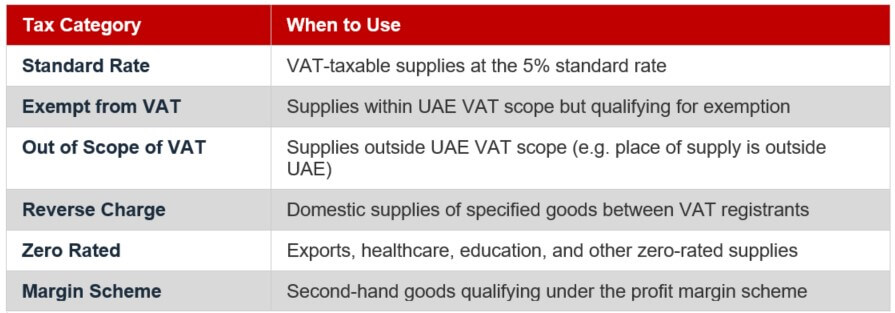
Tax Category Codes
Each line item on an Electronic Invoice must include a tax category. The six tax categories are:
Eight Invoicing Scenarios with Special Requirements
The guidelines identify eight specific scenarios, each with its own mandatory field requirements and issuance considerations:
1. Free Zone Transactions: Requires beneficiary details in addition to customer details
2. Deemed Supply: No physical exchange with buyer; supplier’s ASP reports to FTA only
3. Margin Scheme: VAT amount displayed as ‘0’ on invoice
4. Summary Invoice: Consolidates multiple transactions within a billing period
5. Continuous Supply: Recurring or milestone-based billing
6. Agent Billing: Disclosed agents can issue on behalf of the principal supplier
7. E-Commerce Supply: Applies to supplies through electronic commerce platforms
8. Exports: Buyer endpoint defaults to predefined code 0235:9900000099 if the buyer has no Peppol ID
Data Storage and Record-Keeping Requirements
The February 2026 guidelines clarify data retention obligations. E-invoice data must be retained for:
- 5 years: Following the Tax Period, for Taxable Persons
- 5 years: From end of calendar year of document creation, for all other Persons
- 7 years: For real estate records
- Additional 4 years: If there is a dispute, ongoing audit, or FTA notification of intent to audit
The guidelines clarify that ‘storing within the State’ does not necessarily mean servers must be physically located in the UAE. Data stored on cloud platforms outside the UAE is acceptable, provided it can be promptly retrieved and provided to the FTA in complete, readable form upon request. This is an important clarification for businesses using international cloud infrastructure.
Penalties for Non-Compliance
The UAE Cabinet has published Cabinet Decision No. 106 of 2025 listing violations and administrative penalties. There are two categories:
- Administrative Penalties: Apply to failures in tax invoicing obligations under the VAT Decree-Law and Tax Procedures Law. These include failing to issue or maintain compliant Tax Invoices.
- E-Invoicing Specific Penalties: Apply specifically to failures in the electronic invoicing system requirements once mandatory implementation dates have passed.
Importantly, penalties do NOT apply during the voluntary phase. If you onboard early and begin exchanging e-invoices voluntarily before your mandatory deadline, you have full protection from e-invoicing penalties. This makes early adoption a smart risk management strategy.
Contact Inditech Middle East to avoid the E-invoicing compliance risk by going live with technically validated, ASP-connected systems well ahead of the mandatory deadline.
Getting Ready: The Four-Step Compliance Journey
The Ministry outlines a clear four-step process for implementing e-invoicing. Here’s what it looks like in practice — and where Inditech fits in:
Step 1: Understand Requirements
Review the applicable laws, understand your transaction types, identify which invoice categories and scenarios apply to your business, and determine the mandatory data fields your systems must generate. Conduct a gap analysis of your current invoicing systems against PINT-AE requirements.
Step 2: Select an Accredited Service Provider (ASP)
ASPs are the backbone of UAE e-invoicing. You must appoint exactly one ASP for all your e-invoicing needs — both sending and receiving. The ASP validates your invoices, converts them to the required XML format, transmits them over the Peppol network, reports tax data to the FTA, and provides your Peppol Participant Identifier.
The onboarding process is initiated through the FTA’s EmaraTax portal. Once you select your ASP in EmaraTax, you’re redirected to the ASP’s portal to complete onboarding. Each Tax Group member must onboard individually and may choose different ASPs.
Step 3: Test End-to-End Exchange
Before going live, thorough testing is essential. This includes testing the transmission of invoice data from your system to your ASP, confirming the receipt of validation messages, testing the receipt of incoming e-invoices from suppliers, and verifying that tax data reporting to the FTA works correctly.
Step 4: Go Live and Manage Changes
Launch with a clear governance model in place — agreed roles and responsibilities with your ASP for error resolution, issue escalation, and handling disruptions in service. After going live, keep your ASP updated on any business changes (VAT registration, joining/leaving a tax group, business closure, etc.) via the reverification process in EmaraTax.
Key Practical Considerations for POS Businesses
The February 2026 guidelines contain several practical considerations that are particularly relevant for businesses relying on POS systems:
- Buyer Without a Peppol ID: If your buyer hasn’t yet implemented e-invoicing and has no Participant Identifier, you must use the predefined endpoint 0235:9900000098. Your POS and ASP setup must accommodate this transitional scenario automatically.
- Foreign Currency Invoices: If you invoice in any currency other than AED, the Tax Accounting Currency must be stated, and the gross payable amount in AED must be included in the designated field, calculated at the Central Bank’s approved exchange rate.
- Multiple Payment Methods: If your POS supports split payments (cash, card, credit), these can all be captured in the Payment Instructions field on the electronic invoice.
- Advance Payments and Prepayments: Use the Paid Amount and Preceding Invoice Reference fields to properly link advance payment invoices to final settlement invoices.
- Discounts and Surcharges: Item-level discounts are captured in Line Level Allowances; document-level discounts go in Document Level Allowances. Surcharges like municipality levies are captured in Document Level Charges.
- Rounding: Rounding is only applied at the invoice total level (up to 2 decimal places), not at the line-item or tax category level. Your POS system’s rounding logic must align with this.
The Time to Act Is Now
The UAE’s electronic invoicing system is not a distant regulatory concept — it is a live, published, operational framework with firm deadlines that are months away for the first wave of businesses. The February 2026 guidelines from the Ministry of Finance have removed any remaining ambiguity. The rules are clear, the technology is defined, and the penalties are real.
For businesses in the UAE, particularly those using POS systems as their primary point of invoice generation, the message is urgent: your technology infrastructure needs to be ready, your ASP needs to be appointed, your team needs to be trained, and your systems need to be tested — all before your mandatory go-live date.
At Inditech, we’re already helping businesses across the UAE navigate this transition. Our POS e-invoicing readiness solutions are built on a deep understanding of the UAE’s regulatory framework, the Peppol network, and the practical challenges of deploying compliant technology in fast-paced retail and service environments.
Don’t wait until the deadline pressure builds. The earlier you start, the smoother your transition will be — and the sooner you’ll start benefiting from faster payment cycles, reduced disputes, and streamlined VAT compliance.
Ready to make your POS e-invoicing ready? Contact Inditech today for a free readiness assessment and implementation roadmap tailored to your business.
MAIL: info@inditechme.com CALL: 📞 +971 52 232 9689 | +971 52 180 4260 | +971 58 830 2390
Related Posts

Inditech Middle East Achieves ISO/IEC 27001:2022 Certification: Raising the Bar for Retail IT Security in the GCC.
Inditech Middle East Achieves ISO/IEC 27001:2022 Certification: Raising the Bar for Retail IT Security in…

Beyond Points and Discounts: Building Real Customer Loyalty in the UAE
Beyond Points and Discounts: Building Real Customer Loyalty in the UAE Most loyalty programs in…

5 Signs Your UAE Retail Business Needs POS-Ecommerce Integration
5 Signs Your UAE Retail Business Needs POS-Ecommerce Integration If you're running a shop and…