
The Revolutionary Impact of RFID in Retail- RFID Self-checkout Systems and many more.


Retailers are always looking for the best ways to manage inventory, and two key technologies they use are barcodes and RFID. While barcodes have been the go-to solution for many years, RFID is gaining popularity due to its advanced capabilities. In this blog post, we’ll dive into what RFID is, how it’s being used in retail, the costs involved, real-life examples, how the technology works, what is an RFID Self checkout system, how it helps to enhance the shopping experience for customers and staff while boosting sales, etc
In recent years, RFID (Radio Frequency Identification) has quickly moved from a niche technology to a key player in the retail industry, delivering significant business benefits globally.
Retailers are increasingly adopting this technology to keep pace with change. As per the recent Accenture survey report, RFID is a top choice for 80% of retailers worldwide.
What is RFID? How it works?
RFID stands for ‘radio frequency identification technology.
RFID technology uses electromagnetic fields to identify and track tags attached to objects automatically. An RFID system consists of three main components,
Tags: These are microchips attached to an antenna, which stores data about the item to which it is attached.
Readers: These devices emit radio waves and receive signals back from the RFID tags. The reader converts these signals into digital data.
Software: This processes the data collected by the readers, providing actionable insights and integrating with other systems.
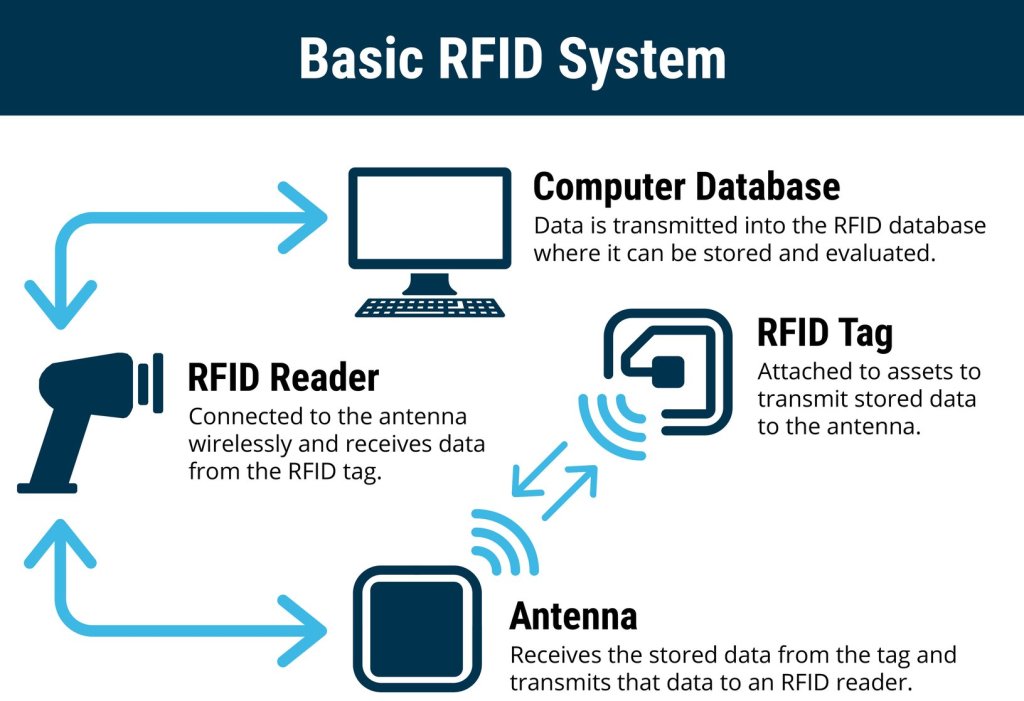
RFID belongs to a group of technologies called automatic identification and data collection (AIDC). AIDC tools help identify items, collect data about them, and send that data to a computer system with minimal human interaction. For retailers needing to track stock accuracy, an RFID system that integrates with inventory can significantly enhance efficiencies. It improves inventory accuracy and visibility, creating better shopping experiences for today’s Omni channel shoppers.
Benefits of RFID in Retail
The retail industry may benefit greatly from RFID technology, which can help businesses boost customer satisfaction and operational efficiency. RFID helps with inventory management by giving real-time visibility into inventory levels, minimizing overstock and stockout scenarios, and facilitating accurate inventory monitoring from the warehouse to the sales floor. RFID helps avoid loss and reduces shrinkage by accurately monitoring things. It makes it more difficult for objects to be lost or stolen without being noticed. When it comes to operational efficiency, using RFID to automate the inventory counting process greatly cuts down on the time and effort needed for stock management, freeing up employees to concentrate on other important duties like customer care. Another significant advantage is an improved customer experience since precise inventory data guarantees that goods are accessible when customers need them.
RFID Self-Checkout system for modern retailers
RFID has revolutionized the self-checkout process, making it faster and more convenient for customers. Customers place items with RFID tags on a designated area/ basket in an RFID self checkout system. All items are scanned simultaneously by the RFID reader; The POS displays the total amount to be paid.
This system reduces the time spent at checkout counters, minimizes human errors, and provides a seamless shopping experience. It also frees up staff to assist customers with other needs. Customers benefit from a quick and hassle-free checkout process, enhancing their overall shopping experience and increasing their likelihood of returning to the store.
How Decathlon Implemented RFID Tags and RFID self checkout systems
Decathlon, a global sports retailer, has successfully implemented RFID technology across its operations, setting a benchmark for the retail industry. Decathlon introduced RFID tags to all its products, enabling precise tracking from production to the point of sale. The implementation required updating their inventory management systems, training staff, and integrating RFID readers at various checkpoints. RFID systems assign unique EPC numbers to each item to match the product SKUs. In RFID systems, each product or asset is identified by an EPC number, like a barcode.
With the implementation of RFID self checkout systems and tags, Decathlon achieved a 98% inventory accuracy rate, reduced stockouts, and improved overall operational efficiency.
Future of RFID in Retail
The future of RFID in retail looks promising, with continuous advancements and increasing adoption rates. According to the Accenture company survey report, the retail RFID market is expected to grow significantly in the coming years. The integration of RFID with the Internet of Things (IoT) will provide even greater visibility and control over inventory and supply chains, enabling more intelligent and automated retail environments.
RFID can provide enhanced customer insights, promote sustainability, and offer innovation in the shopping experience.
As retailers continue to adopt and innovate with this technology, we can expect to see even more significant improvements and a more seamless shopping experience for consumers.
If you are a curious retailer who wants to know more about RFID self-checkout systems for retail stores in Dubai, here we are to help you out in all ways. Call us now at +971 4 388 5756, +971 52 180 4260,+971 52 904 5457.
Related Posts

Inditech Middle East Achieves ISO/IEC 27001:2022 Certification: Raising the Bar for Retail IT Security in the GCC.
Inditech Middle East Achieves ISO/IEC 27001:2022 Certification: Raising the Bar for Retail IT Security in…

Beyond Points and Discounts: Building Real Customer Loyalty in the UAE
Beyond Points and Discounts: Building Real Customer Loyalty in the UAE Most loyalty programs in…

5 Signs Your UAE Retail Business Needs POS-Ecommerce Integration
5 Signs Your UAE Retail Business Needs POS-Ecommerce Integration If you're running a shop and…